PART I — SETTING
1.3
Why Ships Mattered More Than Roads
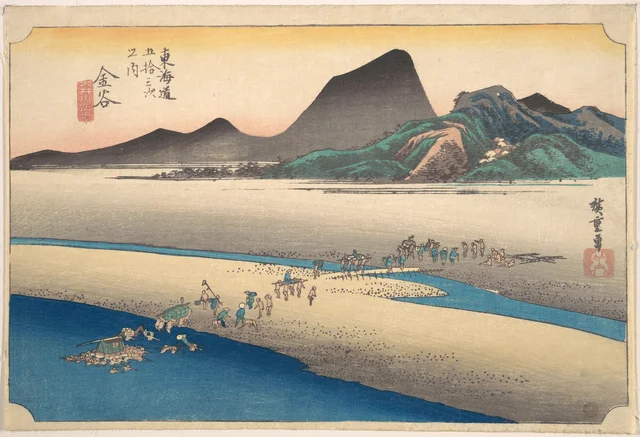
Utagawa Hiroshige, 'Kanaya: The Far Bank of the Oi River,' The Fifty-three Stations of the Tokaido (Hoeido Edition), c. 1833-34. The Metropolitan Museum of Art. Public domain.
The transport network of Edo-period Japan would strike a European reader as bizarre. Eighty per cent of the landmass is steep mountain. And the Tokugawa shogunate, for reasons of military defence, deliberately refused to build bridges over the major rivers.
A Country Without Bridges
Every major river meant hiring porters to carry your goods on their shoulders. Heavy rain triggered kawadome — a river blockade that could strand travellers for days. Japan's interior was deliberately designed to prevent the movement of bulk cargo.
The inland was deliberately impassable.

1 horse / 100 kg
× 1,000 =

1 kitamaebune / 100,000 kg
The Japan Alps form a continental-scale weather wall, dividing the country in two.
The Sea as the Only Option
A single packhorse carried about 100 kg. A kitamaebune carried 100 tonnes — the equivalent of a thousand horses.
The Inversion
This asymmetry reshaped society itself. A samurai class that controlled the roads. A merchant class that controlled the sea. In practice, the latter held the former in economic subjection.