PART II — THE KITAMAEBUNE
2.3
The Ship
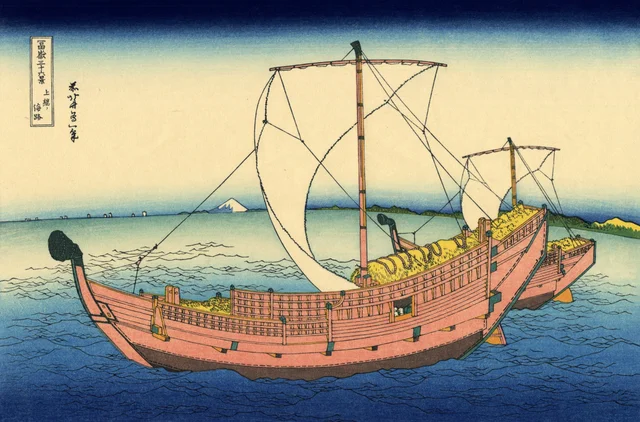
Katsushika Hokusai, In Sea off Kazusa. From the series Thirty-six Views of Mount Fuji, c. 1830–32. Colour woodblock print. A bezaisen cargo ship loaded with rice bales under full sail, with Mount Fuji on the horizon. Public domain.
The bezaisen, the workhorse of the kitamaebune fleet, would not look like a serious cargo vessel to European eyes. One mast. One sail. But this was not primitive. It was radical.
Minimal by Design
A single enormous sail enabled a skeleton crew. A deeply curved bow cut through the Sea of Japan's swells. A shallow draught allowed entry into the smallest fishing harbours.
Same capacity, different philosophy. The bezaisen carried equivalent cargo with one mast, one sail, and a third of the crew.
The Philosophy of Subtraction
The bezaisen was the ultimate optimisation: not designed to solve a problem universally, but to fit a specific environment perfectly.
The bezaisen is not an artifact of the past. It is the earliest expression of Japan's design philosophy.
Total Environmental Fit
The aesthetic of subtraction was inherited by later Japanese engineering. From Sony's transistor radio to Toyota's kanban system — the prototype was on the sea in the eighteenth century.