PART I
Setting
The world before the ships. Time, geography, hierarchy.
PART I — SETTING
1.1
European Time, Japanese Time
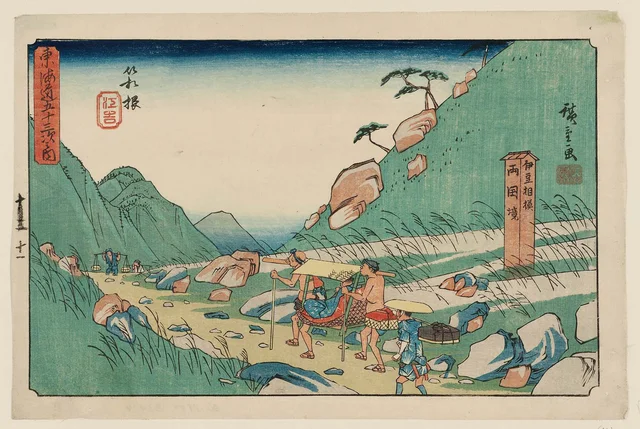
Utagawa Hiroshige, 'Hakone: The Boundary between Izu and Sagami Provinces,' Gyosho Tokaido series, c. 1841-42. Public domain.
In 1603, when Tokugawa Ieyasu seized power and Japan's long closure began, William Shakespeare had just finished King Lear. When that closure ended in 1853, Karl Marx had already published The Communist Manifesto, and the world was deep into the Industrial Revolution.
The Stereotype
For us Europeans, the two and a half centuries called the 'Edo period' tend to collapse into a single, homogeneous era — samurai, beautiful woodblock prints, geisha. But 250 years is longer than the entire history of the United States. It spans the equivalent of Tudor England to Victorian England: a period in which Europe reinvented itself several times over. Japan did too. Just differently.
A parallel reading. Two centuries of European turmoil mirror two centuries of Japanese consolidation.
Modernisation Without Motion
While the borders stayed closed, a society unlike anything the world had seen was taking shape inside. Not military power but finance. Not land but logistics. Not war but contract. These became the forces that drove a nation forward — a form of modernisation that predated the Industrial Revolution by a century, and operated on entirely different principles.