PART III
The Present
What survived. What is disappearing. What an observer-publication is for.
PART III — THE PRESENT
3.1
Where the Trains Went
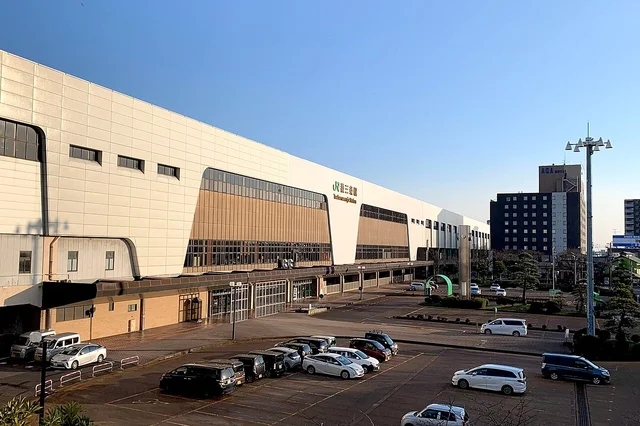
Tsubame-Sanjo, Niigata.
Photograph by 663high, licensed under CC BY-SA 3.0 via Wikimedia Commons.The railway revolutionised logistics. But it did something else. It imposed a template — the 'station front' — on nearly every city in the country, rewriting the entrance to each one in the same idiom.
The Same View Everywhere
Takasaki, Mito, Hachiōji, Hamamatsu — the view from any station exit is nearly identical. The same convenience stores, the same drugstores, the same chain cafés. Only the sign tells you which city you are in.
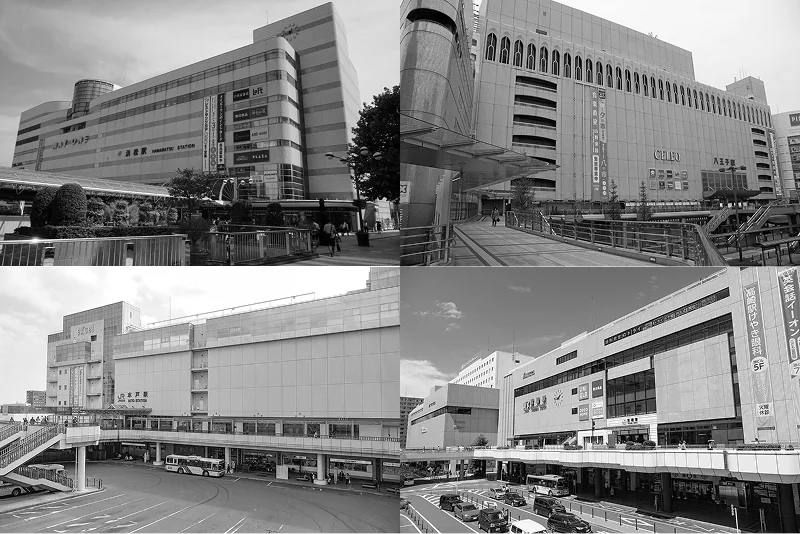
4 cities, 1 view.
Photographs (Takasaki and Mito by Kansai, Hachīoji and Hamamatsu by Toyotama-san) licensed under CC BY-SA 3.0 via Wikimedia Commons.Did they see Japan, or did they see the front of its train stations?
Where the Trains Did Not Go
The Shinkansen's main arteries still run along the Pacific side. Tokyo–Nagoya–Osaka–Hiroshima–Fukuoka: the Golden Corridor. The Sea of Japan coast was left to local lines. Most of the ports that once thrived under the kitamaebune now sit on the periphery of the railway map.
Distance, as a measure of significance, is measured by train schedules.