KITAMAE
Empire of Sails
Browser-based · Phone or desktop · Free during the prototype
Mederu OÜ — Tallinn, Estonia
The Bloomberg Terminal existed in 1850. You just didn't know it yet.
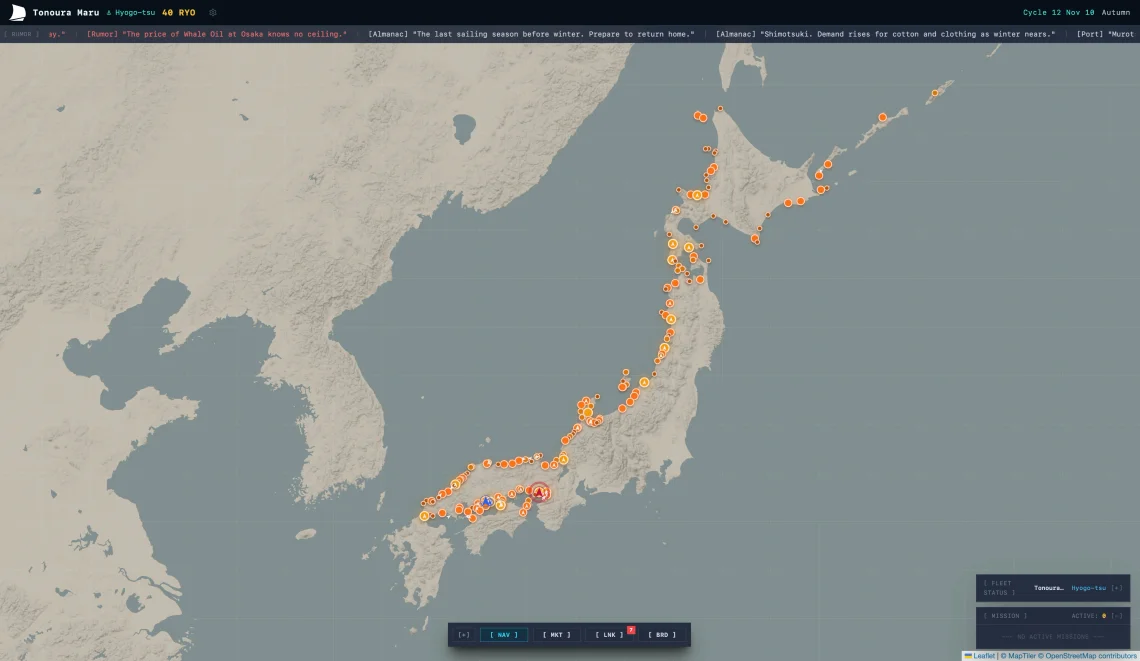
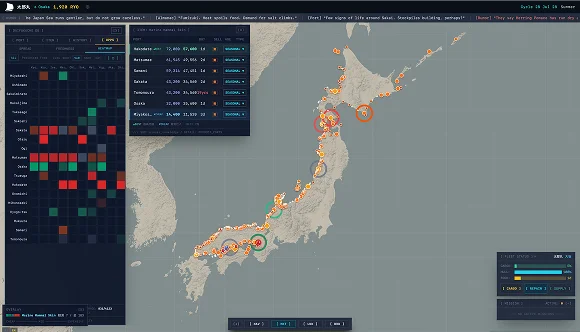
KITAMAE isn't a sailing game. There are no sails to trim, no ships to steer. You run a maritime trading house in Japan, from the mid-18th to the 19th century — fleets at sea, prices in every port, weather over the Sea of Japan — all from a single terminal. Glance at it the way you'd glance at the markets. On your phone, between meetings. On the train home.
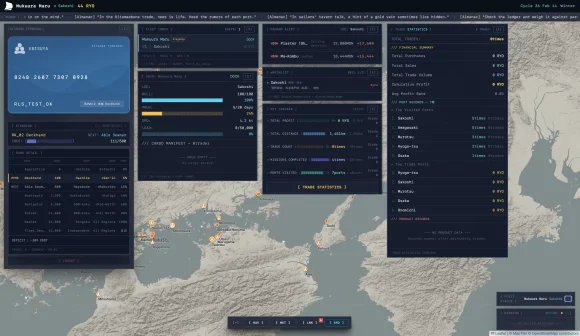
One screen, everything at once. Your personal terminal — rank, standing, line of credit. Your fleet. The day's demand alerts. A watchlist of commodities you've been tracking. Performance metrics climbing toward your next rank. Total profit, total distance, ports visited, voyages closed. Every number a Bloomberg trader watches by reflex — in a world from the mid-18th to the 19th century.
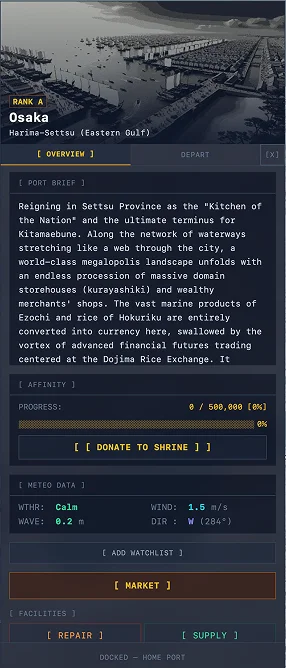
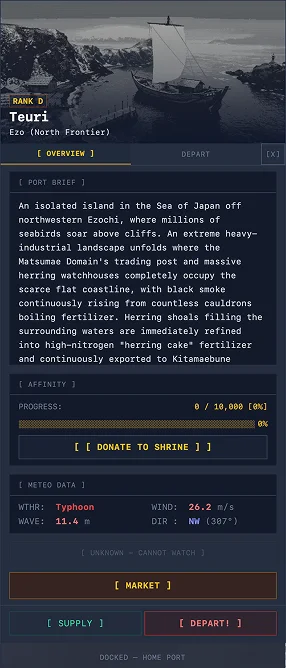
Every port carries its own dossier. A monochrome image of the harbor. A historical brief, written like an editorial entry — what made this place matter, in plain prose. The current sea state: wave height, wind direction, weather. Your accumulating affinity with the local merchants. Donate to the shrine often enough and you become a known patron. The terminal remembers.
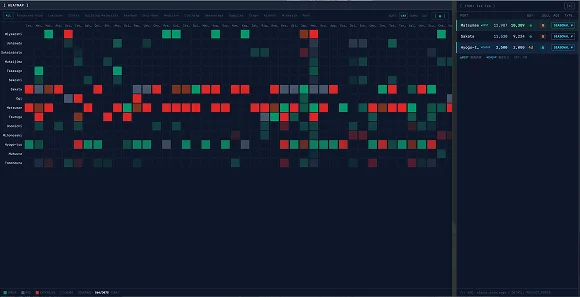
A color matrix of the entire economy. Ports down the y-axis. Commodities across the x. Green cells are cheap, red are expensive, gray is fair value. The whole Sea of Japan in a single glance — patterns leap out the moment you see them. Hakodate's herring meal green against Osaka's deep red. The seasonal swings in lacquerware. The chronic surpluses of rapeseed oil. Every voyage a boatman logs fills in another cell.
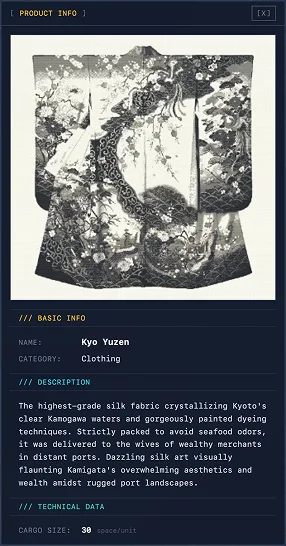
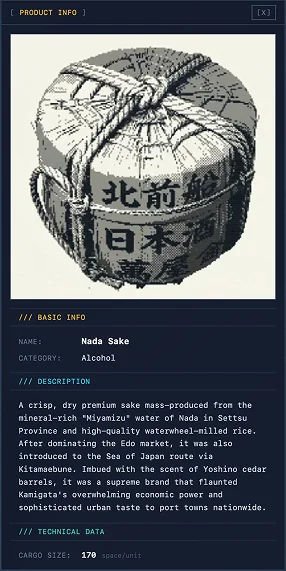
Every commodity in the system is a historical good. Tap any item and the terminal opens its dossier: a museum-quality image of the artifact, the cultural and economic context of its production, the trade logistics that moved it along the Sea of Japan coast in the 19th century. KITAMAE is, quietly, an encyclopedia of Japanese material culture.
A 24-month price history is one tap away. Toggle between intraday, weekly, and monthly views. Spot the seasonal swings, the post-storm spikes, the slow grinds toward equilibrium. The terminal speaks the language of every financial trader you've ever met — but the underlying assets are rice, herring meal, and lacquerware.
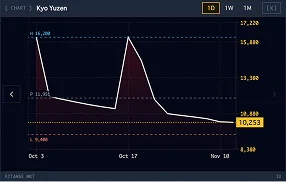
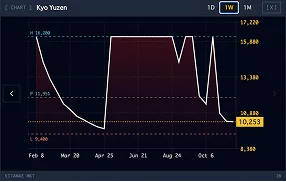
Three things the screenshots can't quite show.
This is a live market, not a static price table. Every price is computed in real time from base value, port rank, production modifiers, current inventory ratios, price elasticity, and seasonal coefficients. Over 1,000 boatmen buy and sell into the same shared market — every transaction moves the price for everyone.
A ship rides badly when it sails too light: with too little cargo in the hold, it sits high and loses its footing against the waves. So the weight you carry is never just cargo — it is what keeps you steady in a heavy sea. Load too little, and you risk the swell taking it all. This is the first rule of the water, and it holds whether your ship is small or the largest on the coast.
Profit is a means, not the goal. Trade honestly with a port's merchants, year after year, and they come to know your name. Donate to shrines, invest in struggling harbors, and your Toku rises — and the kami of the coast take note when storms come. Commission a stone torii gate for a harbor shrine, and your name is carved into it permanently. You are not just trading. Your name takes root on this coast.
183 harbors. Every one of them real. Every cargo historically sourced.
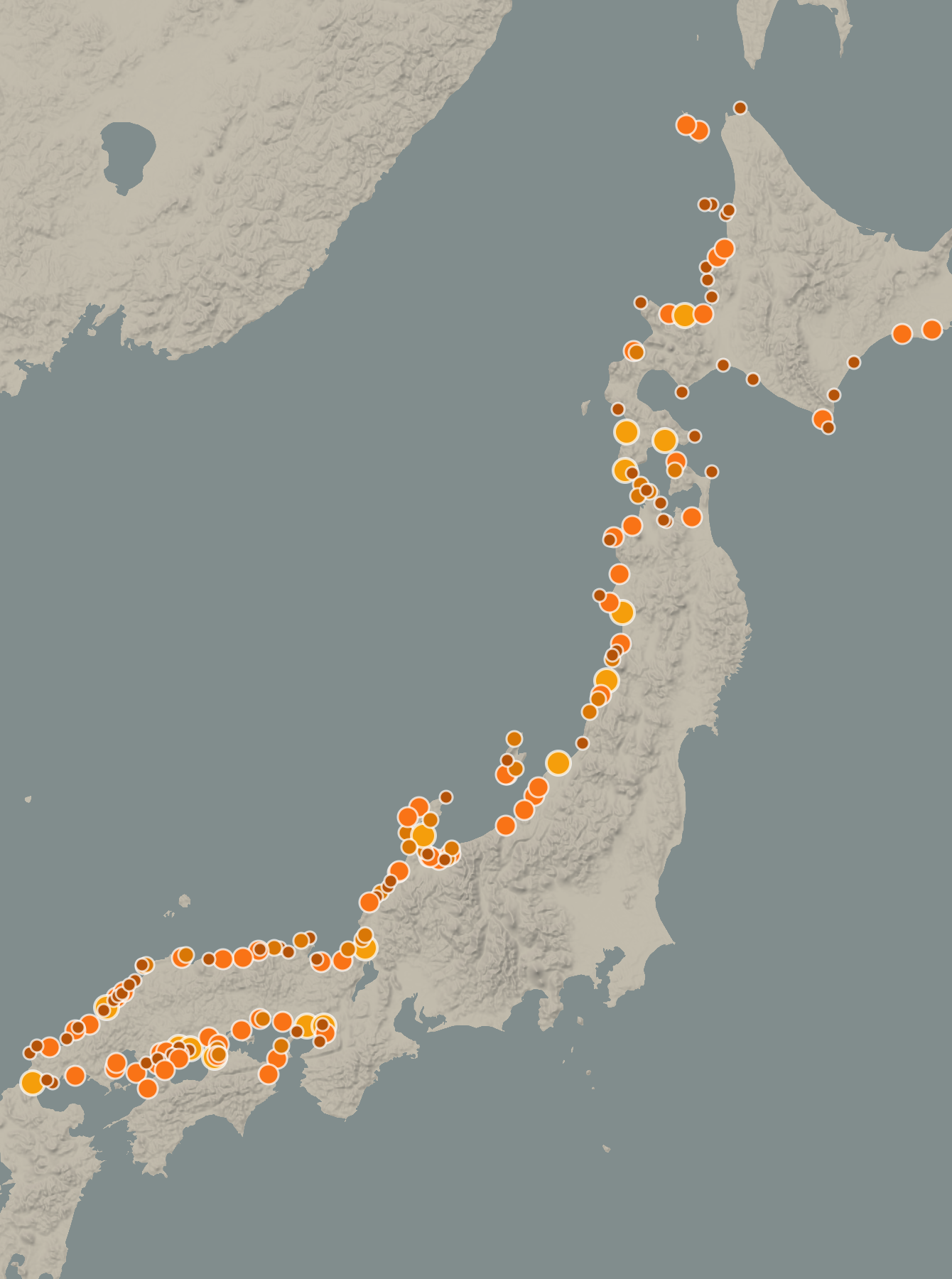
Each port in KITAMAE carries the goods it actually traded from the mid-18th to the 19th century. Sakata moves rice and safflower. Hakodate deals in herring and kelp. Tsuruga handles textiles from Kyoto. The geography is real, the trade goods are real, and seasonal advantages rotate — there is no single best route.
From the great rice ports to the kazamachi — all locations are verifiable.
From a borrowed boat to a fleet of your own.
Eight ranks. The actual hierarchy of a kitamaebune crew. You start as a cook's apprentice on someone else's ship. Every rank above is earned — at sea, in trade, year by year.
RK_01
炊
かしき
Apprentice
The cook. Every fleet owner started here.
RK_02
水主
かこ
Deckhand
Your hands begin to know the work.
RK_03
若衆
わかしゅ
Able Seaman
Skilled enough to be left alone.
RK_04
親父
おやじ
Boatswain
The deck moves at your word.
RK_05
表仕
おもてし
Navigator
Wind, current, star — your instruments.
RK_06
知工
ちく
Purser
The trade lives in your ledger.
RK_07
船頭
せんどう
Master
The ship answers to one voice. Yours.
RK_08
船主
ふなぬし
Fleet Owner
You no longer sail. You decide who sails.
Ownership is where you arrive — not where you begin.
This hierarchy ran on the kitamaebune from the mid-18th to the late 19th century.
The winter Sea of Japan has sunk better boatmen than you.
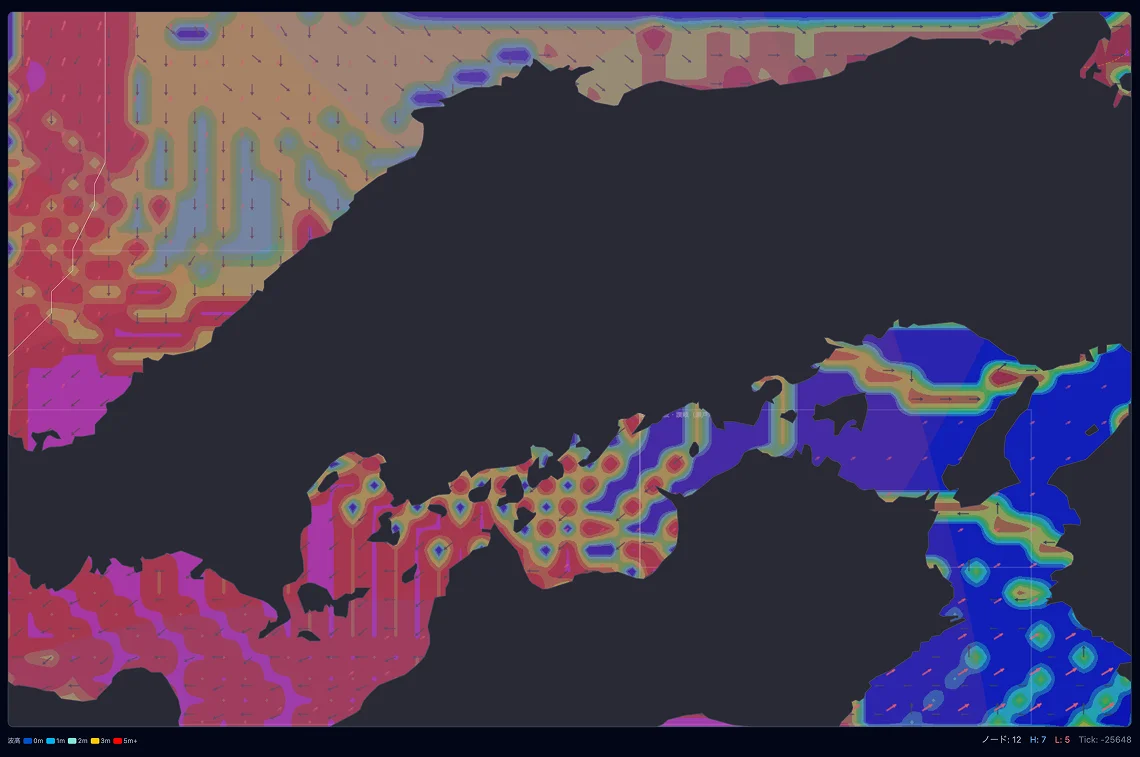
Under the hood: real atmospheric modeling — pressure systems, wind vectors, wave height, and the Tsushima Current — drives every voyage in the simulation.
In KITAMAE, the sea is the same — a live weather simulation, built from historical records of the 19th-century coast. Low-pressure systems form and dissipate. Storm fronts move across the map as the days pass. Winds shift hour by hour. The Tsushima Current is plotted into every routing calculation.
From November to March, the northwest monsoon turns the coast into water no benzai-sen was built for — waves overrun the hulls; ships that sail too light go down without a witness. The brave sail anyway, and find every port paying scarcity prices. The patient wait the season out in harbor — repairing what the autumn damaged, turning idle hands to rope and straw mats, the off-season trades that kept a kitamaebune crew alive through the dark months.
A game that wants to send you to Japan — properly.
The ports in KITAMAE stand on the Japanese coast today. They line the Sea of Japan from Hakodate to Osaka, just as they did in 1850 — but most go unvisited, invisible to the railway-centric tourism that funnels millions toward Tokyo and Kyoto and nowhere else.
KITAMAE makes you remember the names: Sakata, Tsuruga, Tadotsu — not Shibuya. BOREAL tells you what those names actually carry — the crafts still made, the foods still eaten, the people still working there. Together, they point toward a Japan the railway doesn't reach.
Play the routes. Read the ports. Walk the coast.
Shifting perspectives through play and narrative.
Mederu OÜ is a small independent studio based in Tallinn, on the eastern edge of the Baltic Sea. We design games as instruments — for changing how people see, for redirecting attention, for putting overlooked things back on the map.
KITAMAE is our debut title. Our attention runs across scales — from the quiet frictions of daily life to the slow, complex problems that span the world. We start with Japan's port towns.
EARLY PROTOTYPE
The ledger opens Friday, July 24. From there, we quietly gather our first 1,000 boatmen — and send invitations out in waves as we go.
Submit the form below using your Google-linked email. There are no automated confirmation emails or digital queues to monitor. We simply record your name in our ledger. It stays open until we reach 1,000 boatmen.
Every week or two, a few hundred boatmen receive a quiet invitation in their inbox. If weeks pass and you hear nothing, you may have mistyped your address — simply leave your name again. We are in no rush.
Your invitation contains a link to the docks. Click it, authenticate with your Google account, and your trading terminal opens immediately. No heavy downloads, no complex setup. You are given your first modest ship, and the history begins.
Your application has been received.
You're in the ledger. When a wave opens, an invitation will arrive at this email — sign in with your Google account when it does.
A few more things.
What kind of game is this?
A historical trading simulation, set in the world of Japan's coastal shipping from the mid-18th to the 19th century. There is no combat, and nothing tests your reflexes: you buy, ship, and sell. What the game rewards is an eye for markets — spotting a price gap, timing a sale, judging a risk against the weather. No gaming experience required.
How much time does this take?
A few minutes a day, or as many hours as you like — the choice is yours. KITAMAE moves at something close to the pace of real time, so a long crossing takes hours and a new ship takes days, but none of it needs you to watch: set your orders, close the tab, come back to the results. Some boatmen glance at it between meetings; others never quite put it down. There is no end to reach and no clock forcing you on.
Is it free?
Yes. The early prototype is free — no gacha, no energy meters, no pay-to-win.
What do I need to play?
A browser, and a Google account. Phone or desktop, no install — if it can open a news site, it can run a merchant house.
Can my ship sink?
Yes. The winter Sea of Japan is the deadliest water on the map. Sail too light or into the wrong storm, and the ship can go down with everything in the hold. Winter prices are high for a reason.
Can I stream, record, or create content from the prototype?
Yes — screenshots, videos, and live streams of your own gameplay are welcome, including monetized content. Two things to respect: do not redistribute the game itself or wholesale copies of its written works (Dispatch articles, LEDGER chronicles), and do not present your content as official or endorsed by us. Full details are in Section 8.4 of the Terms.
What languages will the prototype support?
English only, to start. We will watch what languages the early boatmen actually speak, and add from there.
How do I withdraw my sign-up or delete my data?
Email privacy@kitamae.app. Withdrawing your sign-up deletes it permanently from our database — deleted, not archived. The same address handles all your GDPR rights, including access and correction, and we respond within the GDPR time limits (normally one month). Details are in the Privacy Policy.
Will there be a wipe / progress reset?
We'll do everything we can to carry your prototype progress into the release. That said, making the game better may call for deep changes under the hood, and we'd rather be honest than promise something we might not be able to keep.
EARLY PROTOTYPE
Seeking a few early boatmen.